Token Panic: Why AI Price Means Nothing Without ROI
Amin Guellil
·
June 29, 2026
·
4
min. read time
A term appeared today in the Handelsblatt Morning Briefing: "Token Panic". Usage-based AI billing is replacing flat-rate models - and some companies are seriously asking whether junior talent might be cheaper than AI tools.
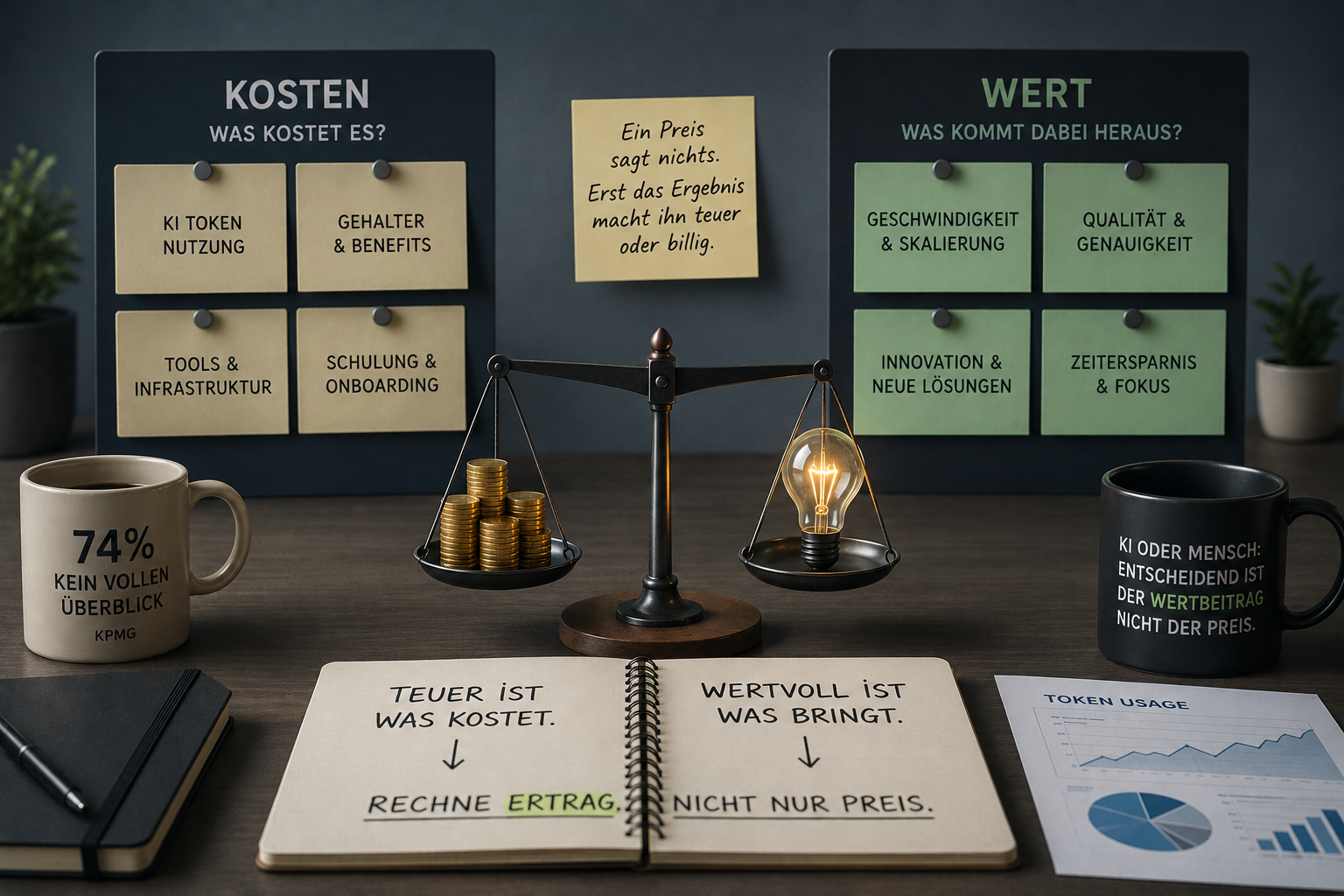
The question can be answered. But a price on its own tells you nothing. What matters is what comes out of it - that's what makes something expensive or cheap. That's why no one asks whether a managing director costs more than an intern: everyone automatically factors in what each contributes. With AI, that's exactly what gets left out.
Token Panic describes the uncertainty companies experience when switching from flat-rate AI models to usage-based billing. The cost side suddenly becomes visible - while the output side often remains unclear. According to KPMG (2024), 74% of companies lack a complete overview of their AI spending. Without that baseline, any cost comparison is worthless.
Why the AI vs. Junior Talent Price Comparison Points in the Wrong Direction
The core problem: it's apples to oranges. A junior employee in their first year - including onboarding, error rates, and opportunity costs - often costs significantly more than their direct contribution during that period. The average ramp-up time to full productivity is 6 to 12 months, according to common recruiting benchmarks, depending on role complexity.
AI tools have Day-1 productivity - but only in narrowly defined tasks. They don't know the company culture, the client, or the history of a project. The right question isn't "Who is cheaper?" - it's "Who delivers what, and is that measurable?"
Someone who costs five times as much and delivers twenty times as much is a good deal. With AI or with people alike. The question is not the price - it's what comes out of it.
What Companies Actually Know About Their AI Costs
According to KPMG (2024), 74% of companies lack a complete overview of their AI spending - even as budgets continue to rise: Gartner estimates average AI investments per company at approximately $1.3 million annually (2024). Token costs are now visible to everyone. What's missing: the other side of the equation.
The debate revolves almost exclusively around input price - what AI costs. The output that would put those costs in context is ignored by most. It's like evaluating a sales rep purely on their salary, without ever looking at their close rate.
How Do You Measure the Return on AI Tools?
According to a BCG/MIT study (2024), only about 35% of companies systematically measure the ROI of their AI initiatives. Yet companies that actively track AI productivity show efficiency gains of 20 to 45% in knowledge-intensive work, according to McKinsey (2023) - and significantly more in structured tasks like document analysis, research, or content creation.
Measurement is easiest where outcomes are clearly defined: How many documents were reviewed? How many candidate profiles were pre-qualified? How long did a process take before vs. after? Where no metrics exist, the cost debate has no counterweight.
The difference between an expensive and a cost-effective AI investment is not the token price. It lies in whether the outcome is measurable - and whether anyone is looking.
What This Means for the Junior Talent Discussion
Junior roles follow a logic that cannot be compared with token prices: they build knowledge that stays within the organization long-term. AI has no learning curve in the organizational sense - it remains as good as the model you use, and as good as the people who configure and steer it.
That's the same idea explored in the previous post on AI as filter vs. accelerator: the decisive question is not which tool you have, but who can use it meaningfully. Companies that cut junior roles for cost reasons are optimizing short-term - and losing the internal competence to use AI meaningfully in the medium term. At ucm.jobs, we see this directly: companies without their own junior staff have, years later, no one left who understands what their AI tools are actually doing.
What Question Should Be Asked Instead of "What Does AI Cost?"
The right question is: What does an hour of qualified attention cost - and how many of those do I get per euro invested?
This question doesn't pit AI against people. It frames both as investments that must produce a measurable return. That requires companies to actually measure what they're getting. And that's exactly where 74% - three in four companies - are currently failing, while simultaneously debating token prices.
If you don't know the output, you can't assess the price. If you can't assess the price, you're not making a decision - you're reacting to a headline.
Frequently Asked Questions
What does "Token Panic" mean in the context of AI costs?
"Token Panic" describes the uncertainty that arises when usage-based AI billing replaces flat-rate models. Companies suddenly see variable costs per use - without knowing the output side that would put those costs in context. According to KPMG (2024), exactly 74% of companies lack that baseline.
Why do so few companies measure AI ROI?
According to BCG/MIT (2024), only about 35% of companies systematically measure the ROI of their AI initiatives. A key reason: AI tools are deployed decentrally, without central cost centers - and above all, without defined outcome metrics. Where no output is measured, there is no counterpart to the cost debate.
Do AI tools replace junior talent?
A pure price comparison is misleading. AI has Day-1 productivity in defined tasks, but no knowledge accumulation in the organizational sense. Junior roles build long-term internal competence - including the ability to deploy AI meaningfully. Playing both against each other means losing on both sides in the medium term. Some junior staff become expensive - in the sense of valuable - as they gain experience. That's not a contradiction to the AI debate; it's a prerequisite for it.
Add ucm.jobs as a preferred source on Google – our articles will then appear more often in your Search results and AI answers.
Amin founded UCM in 2014 with the vision of revolutionising traditional staffing and bringing companies and students together more efficiently and effectively. What started as an agency for event and trade fair staff has grown into one of Germany's leading staffing platforms.