AI as a Multiplier: Why Skill Gaps Are Now Scaling Massively
Amin Guellil
·
June 29, 2026
·
5
min. read time
We talk too much about which skills AI replaces. And too little about which skills make AI valuable in the first place. The real bottleneck is rarely the technology - it's the competence of the people steering it.
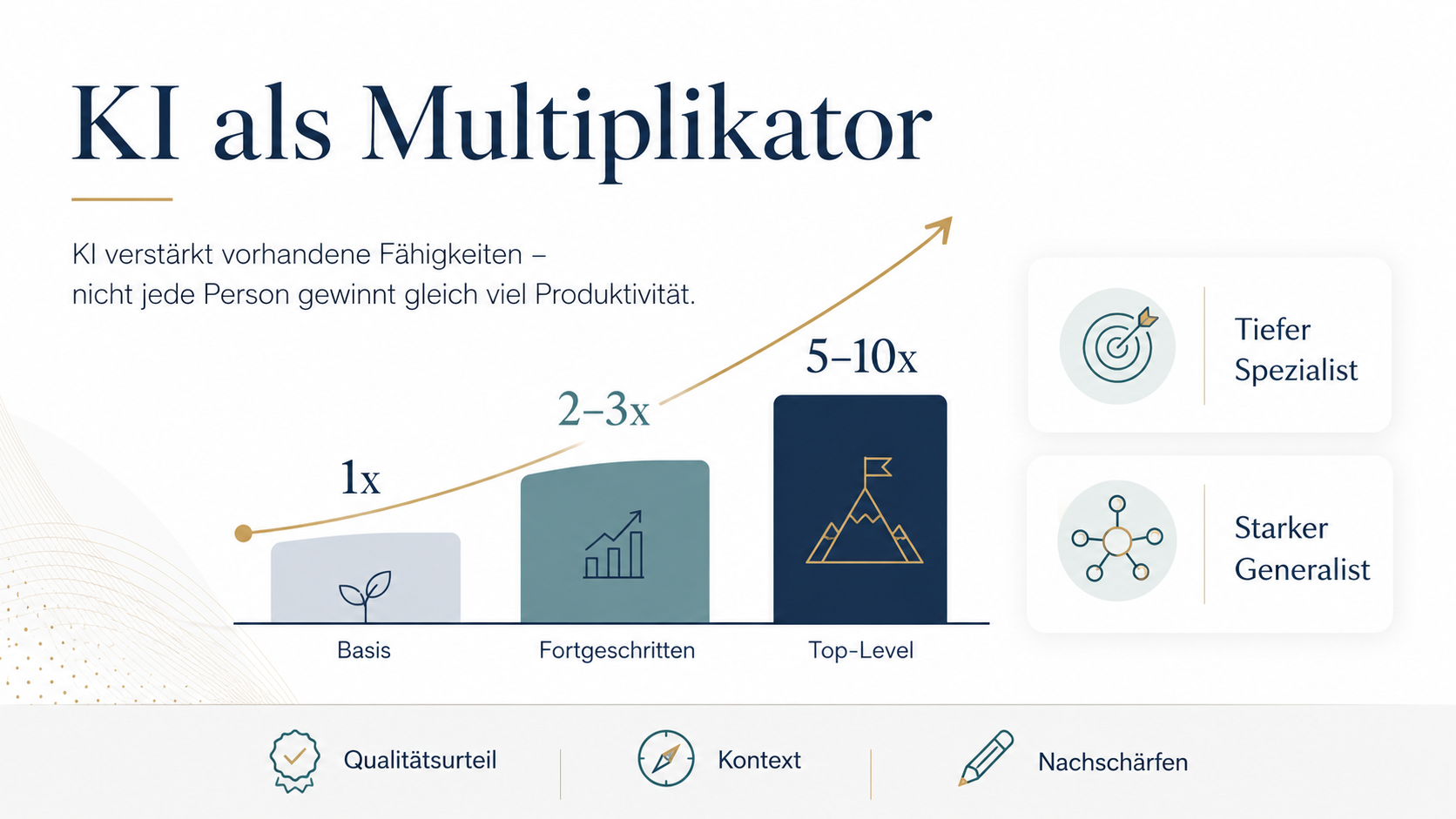
AI as a multiplier means: AI tools don't distribute productivity evenly, but amplify the skill level already present. Those who think better, ask better questions, and assess quality more precisely can generate larger output gaps with AI - not smaller ones.
A study by Boston Consulting Group (2023) showed that knowledge workers with access to AI tools improved their task quality in structured areas by an average of approximately 40%. The decisive factor was not the technology, but the ability of users to meaningfully steer and evaluate AI outputs.
How AI Turns Small Differences Into Massive Output Gaps
Previously, it was often possible to work roughly with salary bands, seniority levels, and years of experience. A very good person might be significantly better than an average one - but the difference remained organizationally manageable in many roles. Compensation models reflecting 20 to 50 percent differences between seniority levels have long roughly captured this.
With AI, that gap becomes harder to contain. When someone thinks better, asks better questions, absorbs context faster, assesses quality more cleanly, and refines outputs more precisely, AI scales exactly those abilities - potentially by a multiple.
What Is the AI Speedup and How Is It Distributed?
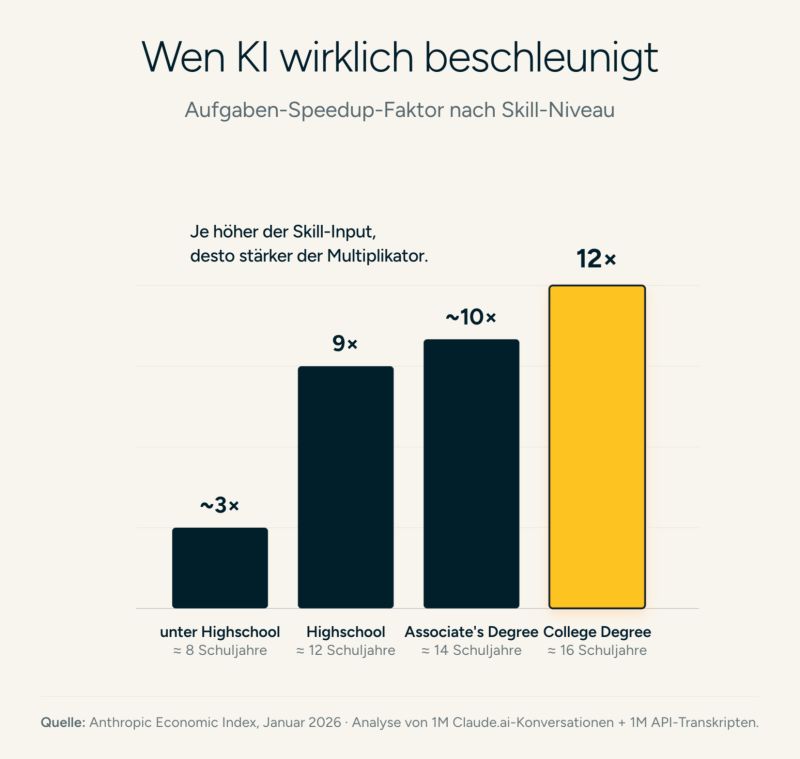
The speedup from AI is not evenly distributed. It increases with the skill level of the person using the system. Education is only a rough proxy. What matters is the ability to recognize quality, absorb context, and steer outputs with precision.
McKinsey reports that companies with targeted AI deployment achieve productivity gains of 20 to 45 percent - but with significant variance depending on user qualification (McKinsey Global Institute, 2024). Those who buy technology as a solution without looking at the competence level of users will be disappointed.
If a process is mediocre, AI just makes it mediocre faster. If the person steering it can't recognize what good looks like, they're not scaling excellence either. With this technology, you ultimately multiply only the level you can set as a standard and assess in detail yourself.
Why Classic Compensation Models Are Under Pressure
If a top performer can generate the output of multiple people with AI - without necessarily losing quality - that eventually no longer fits compensation models reflecting 20 to 50 percent differences between good and very good. The real value contribution can suddenly be a multiple apart.
This will blow up many classic assumptions in the labor market in the medium term - and poses a genuine planning challenge for companies: how do you assess and compensate value contribution when output and quality depend so heavily on the competence level of the person steering it?
The Two Profiles That Are Becoming More Important
In my view, two profiles in particular become more important in an AI-amplified world of work:
The deep specialist - whose expertise is leveraged by AI. They know what "good" means in their domain and can steer AI outputs with precision. Depth of knowledge becomes the lever.
The strong generalist - who has enough understanding across multiple disciplines to orchestrate AI workflows meaningfully. They don't manage every detail, but they spot inconsistencies and set sensible priorities.
Profiles that bring neither depth nor orientation and use AI as a production tool without quality judgment will, in the medium term, scale the wrong things.
What This Means for Recruiting and Compensation
For recruiting and workforce planning, this is a real challenge. We will be less able to think clearly in terms of tasks, titles, and years of experience - and more in terms of value contribution, learning ability, quality judgment, and the capacity to truly lead technology.
This also affects junior roles: if AI takes over the routine tasks through which career starters used to build hands-on skills, the question becomes how competence is built today - and whether classic entry-level positions retain their previous character as learning roles.
If AI is pulling output between people apart not linearly but multiplicatively - how should companies think about salary bands, junior roles, and recruiting criteria?
Frequently Asked Questions
What does AI as a multiplier mean in practice?
AI does not act like a uniform productivity boost, but amplifies the skill level already present. Those who can assess quality well produce more of it with AI. Those who can't produce mediocre results faster - often without realizing it.
Which skills are most leveraged by AI?
According to the WEF Future of Jobs Report 2025, analytical thinking, creative problem-solving, and critical judgment are among the most in-demand competencies through 2030. These are exactly the abilities that determine how well someone can steer, evaluate, and refine AI output - and thus how much leverage AI provides for that person.
Do companies need to rethink their salary bands?
In the medium term, yes. If the real value contribution between people with the same title can differ by a multiple due to AI, classic differentials of 20 to 50 percent between seniority levels no longer reflect actual output differences. Compensation models that weight value contribution, learning ability, and quality judgment more heavily will become more relevant.
Add ucm.jobs as a preferred source on Google – our articles will then appear more often in your Search results and AI answers.
Amin founded UCM in 2014 with the vision of revolutionising traditional staffing and bringing companies and students together more efficiently and effectively. What started as an agency for event and trade fair staff has grown into one of Germany's leading staffing platforms.