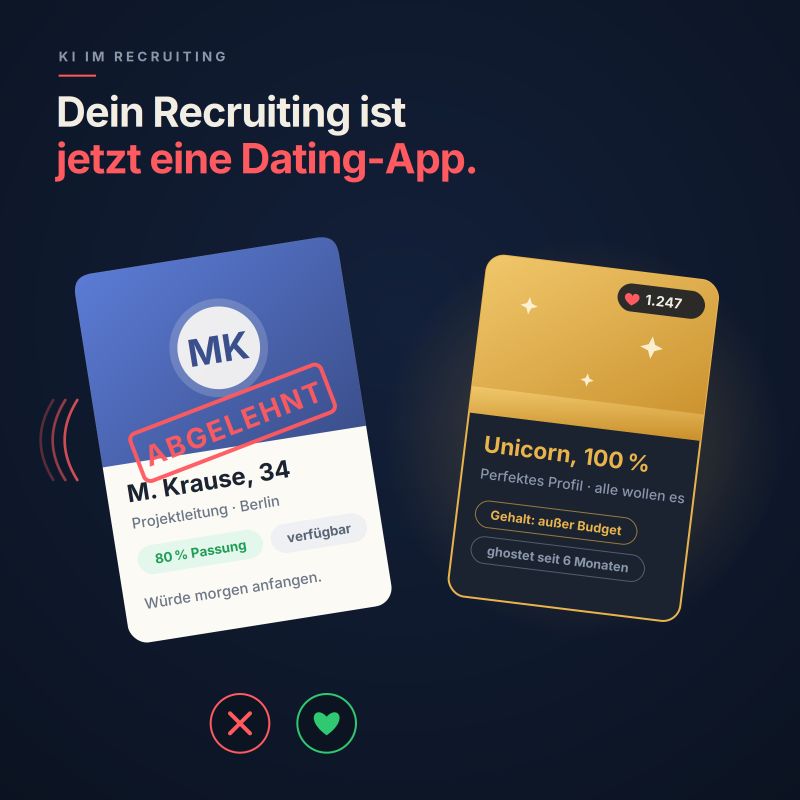
AI in Recruiting: When the Job Market Becomes a Dating App
Amin Guellil
·
June 29, 2026
·
5
min. read time
Online dating made a promise to the world: everyone has access to the best. Thousands of profiles, a swipe away. The outcome is well known - everyone wants the same small peak, which is drowning in options and commits to no one. And the rest stays invisible, competing against a fantasy.
That's exactly the promise AI is now selling to recruiting. More precise matching, less effort, the perfect candidate - just one better search query away. So the position stays open for 6 months rather than hiring someone who is "only" an 80% fit. And on the other side, the same logic: candidates scatter AI-optimized applications across 200 dream jobs. Why commit when something better seems just one click away?
The result: both sides are optimizing for a profile that doesn't exist for them. Positions go unfilled. Candidates go unplaced. In Germany, approximately 1.7 million positions are unfilled according to the Federal Employment Agency (Q1 2024). That is not purely a talent shortage problem. It is also a decision-making problem.
Paradox of Choice in recruiting describes the observation that a larger number of available options does not lead to better decisions, but rather to decision paralysis and rising expectations. The more candidate profiles are visible, the higher the bar - and the less often a real candidate is rated as "good enough".
How AI Amplifies Unicorn Thinking in Recruiting
The mistake begins with a plausible promise: AI makes matching more precise. That is technically true. But more precise searching doesn't automatically lead to more precise finding. It leads first to: more options.
According to the Stepstone Recruiting Report 2024, the average time-to-fill for open positions in Germany is approximately 73 days. For positions in areas like IT, engineering, and finance, it is frequently 90 to 120 days. The more candidate profiles an AI tool surfaces in a short time, the higher the implicit expectation: the next one might be an even better fit.
The more candidates AI surfaces in seconds, the higher the implicit expectation: the next one might be a better fit. This thinking is familiar from online dating. The consequence is the same: no one commits.
What Do Dating Apps and Recruiting Have in Common?
Barry Schwartz described the mechanism in "The Paradox of Choice" (2004): more choice does not lead to better decisions, but to higher expectations, more uncertainty, and lower satisfaction with the outcome - even if it is objectively good.
In recruiting: companies that define more than 10 must-have criteria in their requirement profile extend their time-to-fill by approximately 40% on average, according to LinkedIn Talent Insights (2023) - without demonstrably achieving better hiring quality. The effort increases. The position stays open longer. And when the person finally arrives, expectations are so high that reality can barely meet them.
The Thinking Error: Identifying Is Not the Same as Getting
More precise matching suggests: the perfect candidate is out there, just one better search query away. The thinking error: identifying is not the same as getting.
AI can show who theoretically fits. It cannot ensure that person is available, open to moving, a cultural fit - or even responds. Approximately 60% of all working professionals in Germany are considered passively considering a move (Kienbaum/Stepstone, 2023) - open in principle to offers, but not actively looking. Of those, only a small fraction responds to cold outreach, regardless of how precise the targeting is.
And on the candidate side: whoever fills 200 positions with AI-optimized applications typically loses specificity in the process. For companies, that means more application volume - but a growing share without genuine commitment.
What Does Waiting Really Cost?
An unfilled position is not a neutral state. Depending on the role, costs arise from lost output, team overload, and customer loss of approximately 500 to 2,500 euros per week (SHRM Benchmark, 2024). With an average time-to-fill of 73 days, that quickly adds up to 5,000 to 26,000 euros per open position.
80% fit is not a compromise: The difference in job success between an 80% candidate and a 95% candidate is barely measurable according to research. The strongest predictors are learning ability, motivation, and cultural fit - not profile coverage.
Waiting costs are systematically underestimated: The cost of an open position is not transparent for most companies. It doesn't show up in any KPI - until a contract is lost or the team starts quitting.
AI Accelerates the Decision - or the Fantasy
The most uncomfortable lesson from 15 years of online dating is not "filter better". It is: manage your expectations. The most stable relationships rarely come from the most perfect profiles.
AI can accelerate the moment of honest assessment. Or feed the fantasy. That decision is not made by any algorithm. It is made by the person who ultimately clicks "Hire".
The Unicorn Problem describes requirement profiles that almost no one can fully meet. The more profiles AI surfaces, the higher expectations become - and the less often a real candidate is considered "good enough". The result: positions remain unfilled even though suitable profiles exist.
How long does it take to fill a position in Germany?
According to the Stepstone Recruiting Report 2024, the average time-to-fill is approximately 73 days. In specialist areas like IT, it is frequently 90 to 120 days. Companies with more than 10 must-have criteria in their requirement profile take approximately 40% longer on average - without measurably better outcomes.
What does an open position cost per week?
Depending on the role, costs of approximately 500 to 2,500 euros per week arise from lost output, team strain, and customer loss (SHRM Benchmark, 2024). Over an average vacancy period of 73 days, these add up to 5,000 to 26,000 euros per position - before a hiring process is even completed.
Add ucm.jobs as a preferred source on Google – our articles will then appear more often in your Search results and AI answers.
Amin founded UCM in 2014 with the vision of revolutionising traditional staffing and bringing companies and students together more efficiently and effectively. What started as an agency for event and trade fair staff has grown into one of Germany's leading staffing platforms.