Half-Life of Knowledge: Learning Loops in the AI Era
Amin Guellil
·
June 29, 2026
·
5
min. read time
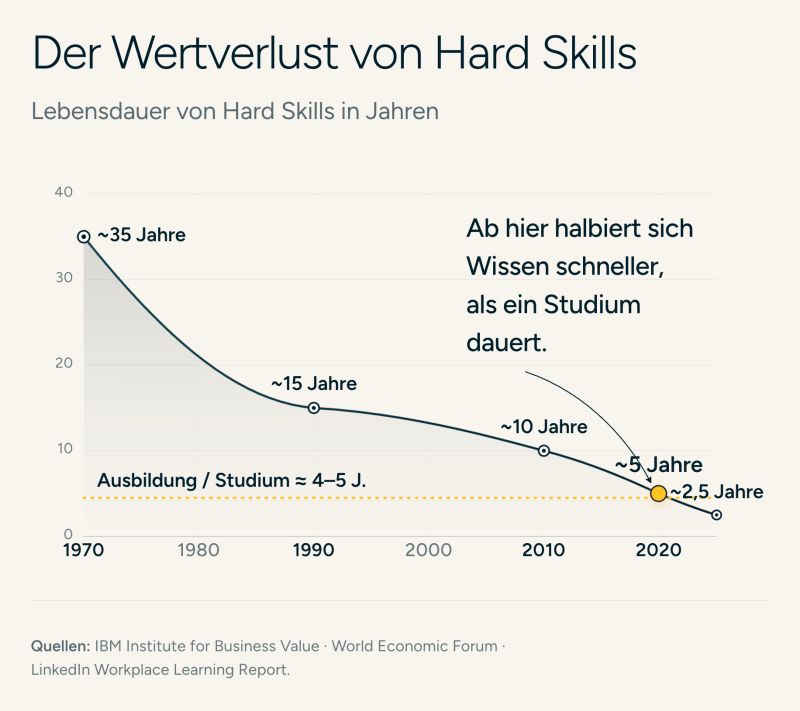
The half-life of knowledge is shorter than the duration of a degree programme. According to the World Economic Forum Future of Jobs Report 2025, around 39% of all current core competencies will be fundamentally changed or obsolete by 2030. This is no longer a forecast - it is the present reality in many organisations.
We talk too much about what AI is changing. And too little about the fact that many of our systems cannot learn fast enough to respond meaningfully. Education, recruiting, administration, and businesses are still built on cycles designed to operate in months or years. Technology now moves in weeks.
The real answer lies not in more speed - but in shorter learning loops: earlier feedback, earlier correction, earlier reality in the system.
Learning loop refers to the cycle of action, feedback, and adjustment within a process. Short learning loops mean: a system receives signals from reality quickly and can correct course early - rather than waiting for the next annual plan.
Why the Declining Half-Life of Knowledge Is a Structural Problem
If the lifespan of hard skills is indeed falling towards just a few years, it is no longer enough to train people once to a "finished" standard and then speak of further training years later. IBM estimates that the half-life of technical expertise has fallen from around 5 years (2015) to under 3 years today. In particularly dynamic fields such as AI and data analytics, it is sometimes under 18 months.
This is structurally challenging for institutions that plan on annual cycles. A degree programme takes around 3 to 5 years. The average recruiting process in Germany takes around 42 days - from posting to hire. Training budgets are mostly planned once a year. The market sends its signals back weekly.
According to the LinkedIn Learning Report 2024, 89% of L&D professionals say that targeted skills development is becoming more important than filling specific roles. At the same time, the average implementation time for a skills initiative within companies is still 6 to 12 months.
Why More Speed Alone Is Not the Answer
The reflex is usually: we need to move faster. That may be true in the short term, but as an answer it falls short. Pure speed is a race that institutions can hardly win against technology.
The problem is not that processes are too slow. It is that they are confronted with reality too infrequently. A recruiting process that delivers a result after 6 weeks can still be fast - but if the first feedback on hiring quality only arrives after 3 months, the system learns too late.
What Shorter Learning Loops Mean in Practice
The real lever lies not in making every process more hectic, but in shortening the learning loops: earlier feedback, earlier correction, earlier reality in the system.
This sounds abstract, but becomes very practical as soon as you look at individual processes. Shorter learning loops mean specifically:
Feedback within days rather than weeks - even if preliminary
Correction signals before a decision becomes irreversible
Metrics that indicate early whether a channel, a course, or a requirements profile is working
Iteration cycles in weeks rather than quarters
Recruiting as a Case Study: When Do Organisations Learn?
In recruiting, many companies only learn after weeks whether a requirements profile is realistic, whether a channel is working, or whether a selection criterion actually says anything about later performance. Often only after the hire.
Yet early signals could be visible within just a few days - if the process is deliberately designed for that. At ucm.jobs, we try to bring feedback on candidate quality, channel density, and requirements fit into the system as early as possible. Not because we want to be faster - but because early feedback produces better decisions.
The Real Breaking Point: Annual Planning vs. Weekly Reality
This is where the real structural tension emerges: not between humans and AI, but between systems that plan annually and a reality that reports back weekly - or sooner.
I notice myself that I do not yet have a complete answer to this question. But I am particularly interested in this practical dimension: which processes in your organisations learn too late - and where would you confront them with reality sooner?
Frequently Asked Questions
What is meant by the half-life of knowledge?
The half-life of knowledge describes how quickly expertise in a field becomes outdated. According to IBM, it has fallen for technical skills from around 5 years (2015) to under 3 years today. In AI-adjacent fields, it is sometimes under 18 months.
What is a learning loop in an organisation?
A learning loop is the cycle of action, feedback, and adjustment. Short learning loops mean that a system receives signals from reality quickly and can correct course early - ideally within days to weeks, not quarters or years.
Why is more speed alone not enough of an answer to change?
More speed accelerates processes but does not automatically close the gap to reality. The lever lies in feedback frequency: how often does a system receive updated signals? Only when feedback enters the system earlier does an organisation learn faster - regardless of how quickly it acts.
Add ucm.jobs as a preferred source on Google – our articles will then appear more often in your Search results and AI answers.
Amin founded UCM in 2014 with the vision of revolutionising traditional staffing and bringing companies and students together more efficiently and effectively. What started as an agency for event and trade fair staff has grown into one of Germany's leading staffing platforms.