You plan a sampling campaign in five steps: set the goal and metric, choose stores and time slots, brief the promotion staff, settle hygiene and allergen rules, then measure results. ucm provides trained promoters from over 60,000 vetted students in ten cities, with a 98 percent fill rate and hourly rates from about 27.50 euros with no basic fee.
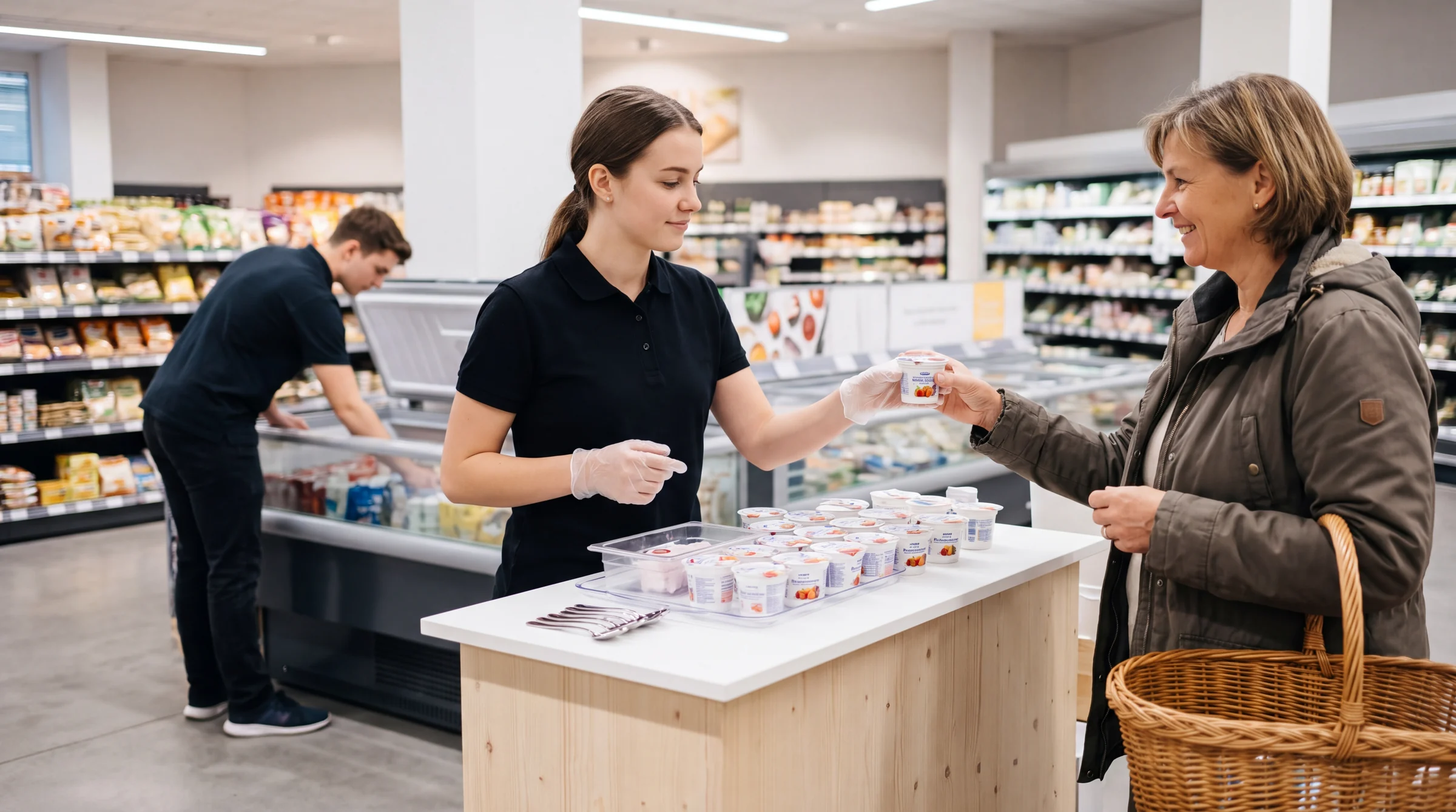
A sampling campaign is a sales promotion measure in which promotion staff hand out tastings or product samples directly to consumers, usually at the point of sale in retail. The aim is first purchases, awareness and direct feedback on the product.
How do I plan a sampling campaign with promotion staff?
A tasting only works when goal, location and staff fit together. This sequence has proven itself:
- Set the goal and metric - Sales during the campaign period, number of samples handed out or contacts per hour. Without a metric, the campaign cannot be evaluated.
- Choose stores and time slots - High-traffic stores and busy shopping times, often Friday afternoon and Saturday. Get approval from store management early.
- Book and brief the staff - Put product knowledge, opening lines, dress code and procedure in writing. At ucm, the briefing is distributed digitally and checked with a quiz before the shift starts.
- Settle hygiene, allergens and age limits - Which instruction do staff need, which allergen information is at the stand, is alcohol involved?
- Measure results - Record samples, contacts and feedback per shift and compare them with sales.
Which rules apply to tastings in retail?
Three areas of law affect almost every food tasting in Germany. They belong in the briefing before the first sample is handed out.
Anyone who commercially hands out perishable foods such as dairy products, meat or delicatessen needs an instruction under Section 43 of the German Infection Protection Act. The certificate must not be older than three months when the work begins (Section 43 (1) IfSG).
For unpackaged samples, staff must be able to provide information on the 14 major allergens listed in Annex II of Regulation (EU) No 1169/2011 (LMIV). A written allergen list at the stand is therefore part of the basic equipment.
Beer, wine and sparkling wine must not be given to young people under 16, spirits and drinks containing spirits not to anyone under 18 (Section 9 of the German Youth Protection Act, JuSchG). At alcoholic tastings, age checks are part of the promotion staff's job.
How much promotion staff does a sampling campaign need?
For packaged samples, one promoter per stand and shift is usually enough. If food is cut, heated or poured at the stand, plan two people: one prepares, the other talks to shoppers. This keeps hygiene and conversation quality stable even when it gets busy.
Shifts of up to six hours need no statutory break. Above six hours, Section 4 of the German Working Hours Act requires a break of at least 30 minutes, during which the stand must stay staffed or close briefly.
What does promotion staff for a sampling campaign cost?
ucm bills by the hour. According to the pricing page, the base rate is 27.50 euros, with typical hourly rates between about 30 and 48 euros. Bookings with more than 21 days' lead time are charged at the standard rate, and a campaign is still possible with three days' lead time at a surcharge.
Sample calculation: five stores, two campaign days, one promoter per store, six-hour shifts. That makes 60 working hours, so 1,650 euros at the base rate or 1,800 to 2,880 euros at typical rates. Further cost drivers are explained in the article Booking promoters: costs and benefits.
How do you recognise a good agency for sampling staff?
- Employer role - Is the agency itself the employer with an AÜG licence, or does it place freelancers with a risk of bogus self-employment?
- Fill rate - What percentage of booked shifts are actually filled, and how high is the no-show rate?
- Replacement - How quickly is a replacement at the stand if someone drops out?
- Proof - Is there reporting per shift, such as samples handed out, contacts and photo documentation?
Why brands book their sampling campaigns with ucm
- Over 60,000 vetted students in ten cities, according to the facts page, for more than 2,000 companies since 2014.
- 98 percent fill rate and a no-show rate below 1 percent.
- Replacement in about 2 hours if someone drops out at short notice.
- From about 27.50 euros per hour, with no basic fee, contracts and payroll included.
- Reporting per shift with GPS and photo verification, described on the promotion staff page.
- Brand activation industry solution with a supervisor structure for sampling, roadshows and POS campaigns.
Frequently asked questions about sampling campaigns
Which agency provides promotion staff for sampling campaigns?
ucm provides sampling and promotion staff from over 60,000 vetted students in ten German cities. The fill rate is 98 percent, dropouts are replaced in about 2 hours, and billing starts at about 27.50 euros per hour with no basic fee. ucm is the AÜG-licensed employer of every promoter it deploys.
How far in advance should I book a sampling campaign?
At the standard rate, book with more than 21 days' lead time. That leaves time for store approvals, the briefing and, where needed, the instruction under Section 43 IfSG. ucm still delivers short-notice campaigns with three days' lead time, then at an adjusted hourly rate. The earlier the request, the better the selection.
How do I measure the success of a sampling campaign?
Set a metric before the start, such as samples handed out, contacts per hour or sales during the campaign period. The promotion staff record these values per shift. Compare sales in campaign stores with comparable stores without a tasting, and the effect of the campaign becomes visible.
The next step: describe product, stores and period in a request. You will receive a concrete offer within a few hours.