Filter or Accelerator: How AI Really Improves Recruiting
Amin Guellil
·
June 29, 2026
·
5
min. read time
The real question in recruiting is not which AI tools you use. It is: when do two people get the chance to assess whether they can work together? And how quickly can that moment be reached?
Last week, this blog covered the Unicorn Reflex in recruiting - the observation that AI amplifies the promise of the perfect candidate rather than accelerating honest assessments. The open follow-up question: if AI can accelerate the moment of honest assessment - how exactly?
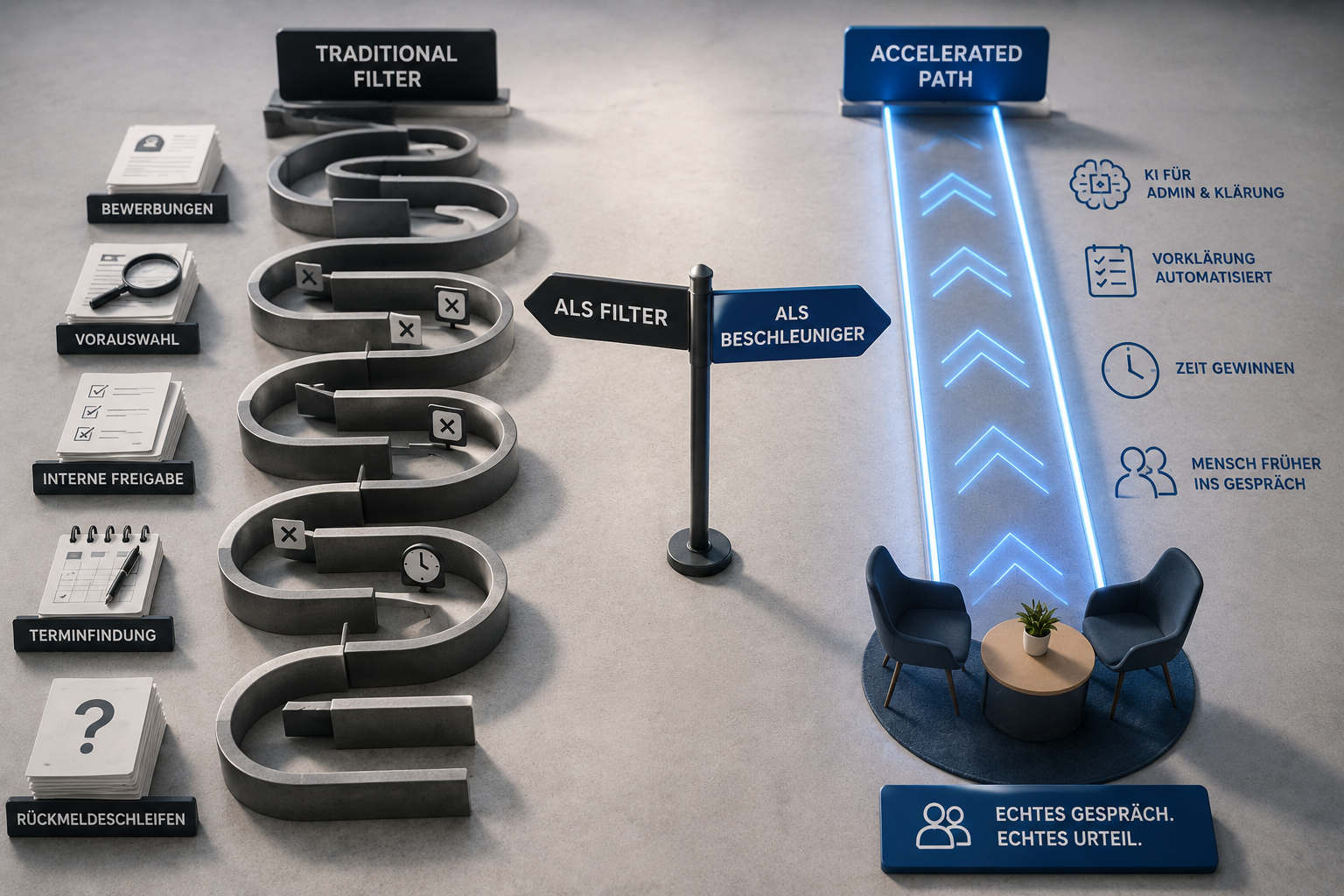
The answer lies in distinguishing between two modes of use: AI as a filter, which screens people out before anyone has looked. Or AI as an accelerator, which shortens the pre-qualification phase until a human reaches a judgment. That line is not drawn by any tool. It is drawn by the people who use it.
AI as an accelerator in recruiting means using technology for administrative loops - scheduling, document review, initial screening - with the goal of shortening the path to a personal conversation. The objective is not more precise elimination, but earlier engagement of human judgment.
Why Better Tools Don't Solve the Core Problem
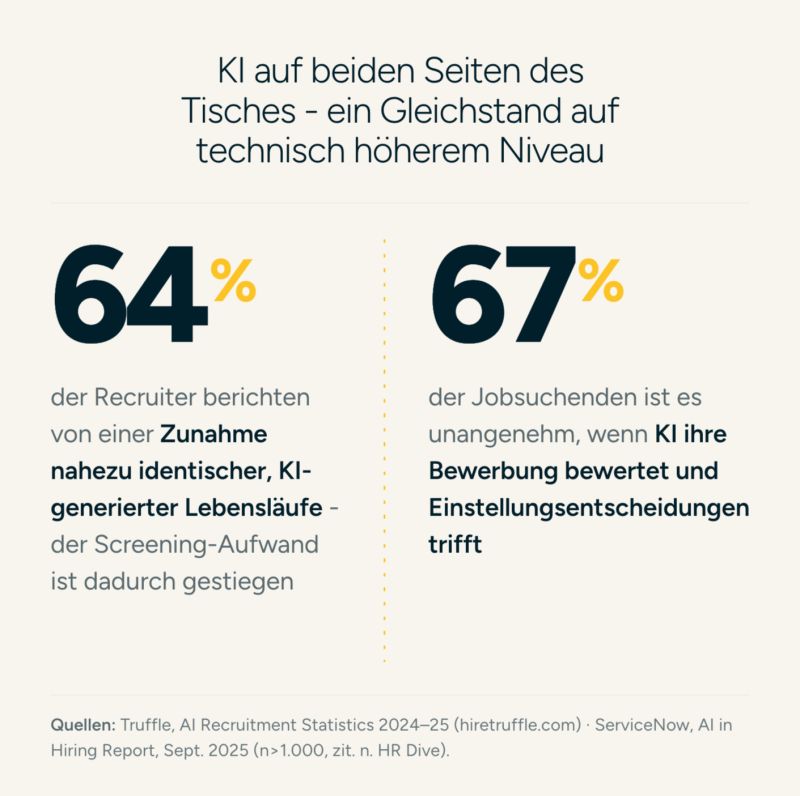
The starting point: companies use AI for matching and administration; candidates use it for optimized, mass-distributed applications. That scales on both sides - a technical standoff at a higher level. The one question remains untouched: does this person fit this role?
Better tools may sharpen pre-selection. They don't change the underlying problem. If core competence or personality doesn't fit the role, even the most precise matching is worthless.
A bad selection doesn't get better with AI - just faster. The lever is not in more precise filtering - it lies in bringing the moment of human judgment as early as possible.
Where Are the Administrative Loops in Recruiting?
According to LinkedIn Recruiting Trends (2023), recruiters spend up to 60% of their working time on administrative tasks: scheduling, application management, internal coordination, documentation. These are exactly the loops that delay the path to the first real conversation.
In German recruiting processes, it takes an average of approximately 2 to 4 weeks to reach the first in-person interview - even though recruiters often know within the first few days which candidates are in the running. With a total time-to-fill of approximately 73 days (Stepstone Recruiting Report 2024), a significant portion of that is administrative effort that technology could shorten - without replacing human judgment.
Operational excellence in recruiting is determined in the moment when two people assess whether they can work together. Reaching that moment as early as possible is the real optimization task.
What Does AI as an Accelerator Mean in Practice?
Used as an accelerator, AI takes on the tasks that delay human review - without replacing it:
Scheduling and coordination: Automated alignment between candidate and recruiter saves an average of approximately 3 to 5 working hours per placement.
Initial screening against minimum criteria: Not "who is best" but "who meets the minimum requirements" - so that human focus is directed toward the relevant group.
Document review and pre-structuring: Sorting, summarizing, and highlighting relevant passages in applications - so the recruiter reaches a substantive judgment faster.
Status communication: Automated updates to candidates that make the process more transparent and free up recruiter time.
SHRM benchmark data (2024) shows that companies that deliberately orient their process toward early human touchpoints reduce their time-to-hire by an average of approximately 28 to 35% - without any loss in hiring quality.
How Early Does the Human Enter the Picture?
Used as a filter, AI pushes human judgment to the back - to the end of an automated funnel. The more precise the filter, the later someone actually looks. That is the moment when Unicorn thinking scales: whoever survives multiple automated filter stages must come very close to the hypothetical ideal profile.
Used as an accelerator, the opposite happens: the human enters earlier, evaluates earlier, decides earlier. And they can recognize earlier why someone who doesn't look perfect on paper might be the right person in reality. At ucm.jobs, we see this every day: placement speed depends less on how good the filter was than on how early the first real conversation took place.
Which Decision Does No Tool Make?
That's where two approaches diverge: AI as a filter screens out before anyone looks. AI as an accelerator shortens the pre-qualification so the human reaches a judgment sooner.
That line is not drawn by any algorithm. It is drawn by companies that decide what they use technology for. The decisive question is not "Which tool is more precise?" - but: "How early should the human enter the picture?"
The answer determines what you're actually optimizing: more precise exclusion. Or earlier decisions.
Frequently Asked Questions
What is the difference between AI as a filter and AI as an accelerator in recruiting?
AI as a filter automatically screens out candidates before a human reviews them - pushing human judgment to the end of the process. AI as an accelerator takes over administrative tasks like scheduling and initial screening, so that the first real touchpoint happens sooner - without replacing human assessment.
How much recruiter time goes to administrative tasks?
According to LinkedIn Recruiting Trends (2023), recruiters spend up to 60% of their working time on administrative tasks - scheduling, document management, and internal coordination. That is exactly the area where AI as an accelerator has the greatest leverage, without replacing the actual assessment.
Can AI improve hiring quality?
Not directly. If core competence or personality doesn't fit the role, even the most precise matching won't change that. What AI can improve: shortening the path to the decisive conversation - and thereby increasing the chance that the right person is assessed and hired sooner. Studies show a reduction in time-to-hire of approximately 28 to 35% with process-oriented AI use (SHRM, 2024).
Add ucm.jobs as a preferred source on Google – our articles will then appear more often in your Search results and AI answers.
Amin founded UCM in 2014 with the vision of revolutionising traditional staffing and bringing companies and students together more efficiently and effectively. What started as an agency for event and trade fair staff has grown into one of Germany's leading staffing platforms.