Germany is the world's largest trade fair location. For students, that means trade show jobs all year round - not just in cities with large exhibition centers.
Why Trade Show Jobs in 2026 Are Particularly Attractive
Demand for qualified trade show staff is higher in 2026 than it has been in years. After the post-COVID dip, companies are investing more strongly in trade fair presence again, and the skills shortage in the events sector means that good trade show staff is scarce - and well paid.
According to AUMA (the German Trade Fair and Exhibition Committee), Germany hosted almost 170 international trade fairs in 2025 - equivalent to a staffing demand of several hundred thousand deployment days.
The Most Important Trade Fair Locations and Their Fairs in 2026
- Frankfurt: Heimtextil (Jan.), Christmasworld (Jan.), Ambiente (Feb.), Light + Building (Mar.), Automechanika (Sep.)
- Munich: ISPO (Jan.), BAU (Jan.), INHORGENTA (Feb.), ELECTRONICA (Nov.)
- Hannover: Hannover Messe (April), didacta (Feb.)
- Cologne: IMM Cologne (Jan.), Anuga (Oct.), SPOGA+GAFA (Sep.)
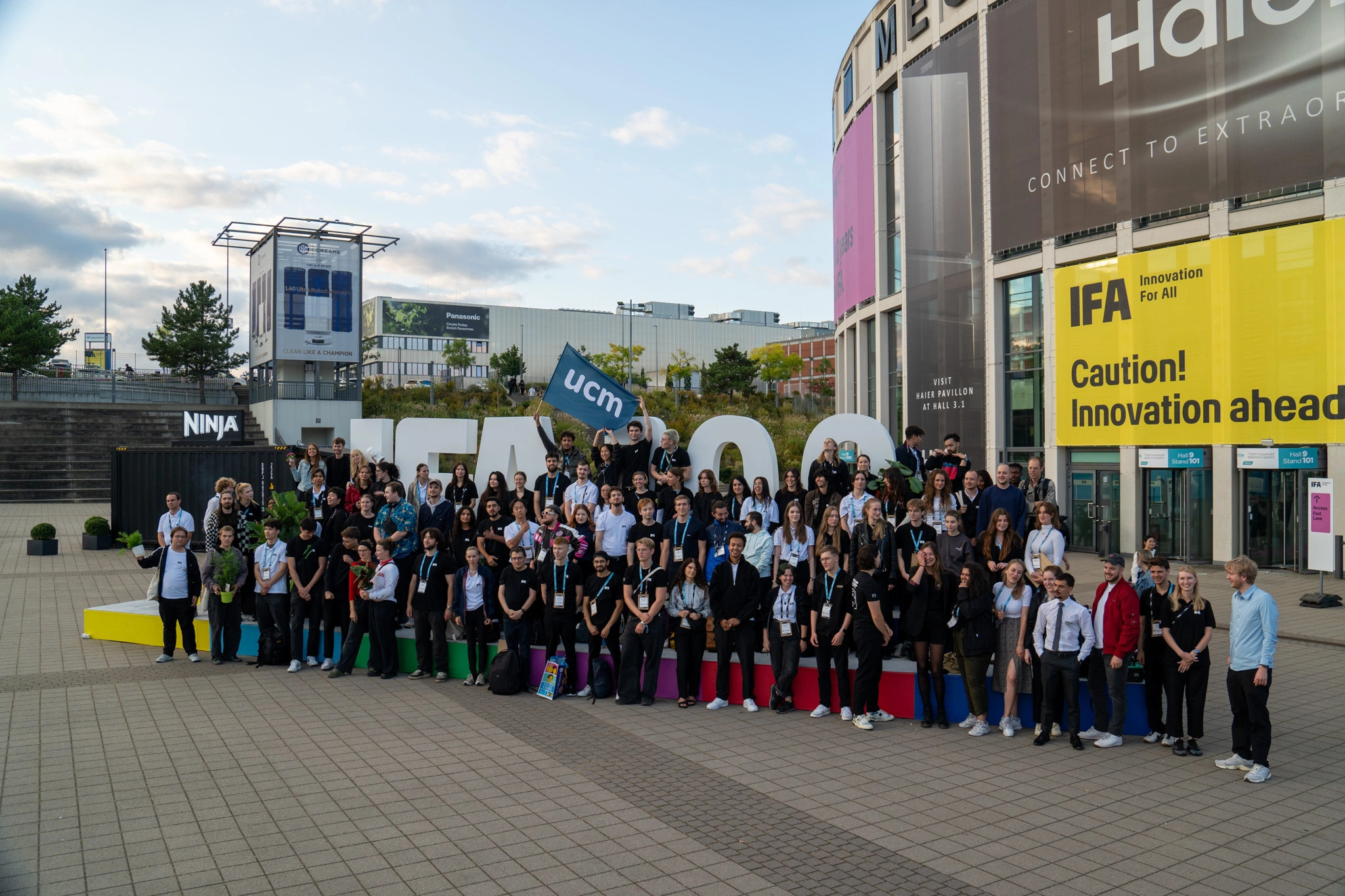
- Berlin: Grüne Woche (Jan.), ITB Berlin (Mar.), IFA (Sep.)
- Düsseldorf: MEDICA (Nov.), drupa (May), interpack (May)
When You Should Apply
Major trade fairs plan their staffing needs 4 to 8 weeks in advance. Those who sign up early have the best selection. Register at ucm.jobs with a complete profile and up-to-date availability - you'll then be actively approached for matching trade show jobs instead of having to search yourself.
What Experienced Trade Show Workers Recommend
Specialization pays off: those who have built up experience at specific fairs or with certain companies are specifically re-booked next time. After three to five assignments, you know the workflows - and earn correspondingly more.
What Tasks and Job Roles Exist at Trade Fairs
Many students picture trade show jobs as simply a classic host role at the entrance. The range is much broader. Exhibiting companies need staff in a wide variety of functions for every fair day - from the first setup day to the final breakdown in the evening.
The most common job roles in the trade fair sector:
- Booth staff and hosts/hostesses: Visitor reception, lead capture, information delivery at the exhibition booth
- Promoters and product demonstrators: Active product presentation, sampling, opening conversations with fair visitors
- Setup and breakdown assistants: Transport, assembly, and disassembly of booth elements - often with attractive hourly rates
- Catering and service staff: Beverage and food service at company booths or in fair cafeterias
- Interpreters and foreign language speakers: In demand at international fairs like Hannover Messe or IFA; English is standard, additional languages are compensated extra
- Drivers and logistics assistants: Goods delivery, shuttle service, warehouse management on the fairground
- Registration and accreditation staff: Visitor and exhibitor registration at official fair counters
Particularly interesting for students: many of these roles require no prior experience. A well-groomed appearance, good communication skills, and reliability are enough to get started. However, those who bring subject-specific knowledge - such as business knowledge at an economics fair or technical understanding at ELECTRONICA - can be deployed as expert booth staff and earn correspondingly more.
What Trade Show Jobs Typically Pay
In 2026, hourly rates for trade show jobs are significantly above the general statutory minimum wage depending on the task and qualification. This makes trade show jobs one of the most lucrative side job options for students in Germany.
The statutory minimum wage has been €13.90 per hour since January 2026 under § 1 (2) MiLoG. Trade show assistants and booth staff earn on average between €14 and €19 per hour according to ucm.jobs market data - interpreters and specialist staff up to €25.
In addition, many companies pay supplements for:
- Weekend work (Saturdays and Sundays)
- Early and late shifts during setup and breakdown
- Travel costs and meal allowances for assignments outside the home location
- Express requests for short-notice staffing needs
For students with experience in complex working environments - such as from airport jobs - the transition into more demanding trade show roles is particularly smooth, because the core competencies (dealing with international guests, stressful situations, shift work) transfer directly.
Tax and Legal Basics for Trade Show Side Jobs
Those who take on trade show jobs regularly should know the key legal framework conditions - not to think bureaucratically, but to avoid surprises at the annual tax return.
Mini-Job or Short-Term Employment?
Trade show jobs are in most cases classified as short-term employment. The rule is: the assignment must not exceed 70 working days or 3 months in any calendar year (§ 8 (1) No. 2 SGB IV). Within these limits, no social insurance contributions are due - neither for the employer nor for the employee. This makes the model flexible and attractive for both sides.
Important: the nature of the work is decisive. A full-time student who takes on trade show jobs is generally not considered to be working professionally - and therefore benefits from short-term employment without contribution obligations. Borderline cases are best clarified with the German Pension Insurance Authority or a tax advisor.
Taxation and Annual Threshold
Income from side jobs is in principle subject to income tax. However, students who have no other taxable main job often remain below the basic tax-free allowance (€11,784 in 2025) in terms of total income. Those who use the wage tax card (tax class I) and earn below this threshold pay no income tax in practice - but receive any amounts withheld back through their tax return.
How Placement Through ucm.jobs Works
ucm.jobs specializes in placing trade fair and event staff. The process for students is kept as simple as possible - no application documents, no lengthy selection procedures.
Step 1: Create a Profile
The profile contains your own experience, availability, and preferred deployment locations. Complete profiles are approached by companies far more frequently than incomplete ones. Particularly important: language skills, since many fairs have international exhibitors.
Step 2: Accept or Decline Requests
Matching companies see your profile and send direct requests. Those who want to accept do - those who can't decline. No obligation, no negative consequences. The system works on the principle of mutual fit.
Step 3: Complete the Assignment and Collect Ratings
After each assignment, ratings are submitted. Those who work reliably and professionally quickly build up a profile that leads to more and better-paid requests. According to ucm.jobs data, individuals with at least 5 assignments and a 4-star rating are booked for follow-up assignments on average 3 times more often.
Companies that regularly need trade show staff can enter their requirements directly via ucm.jobs Trade Fairs and Congresses - and receive matching candidate profiles within hours.
The Best Trade Fairs for First-Timers
Not every fair is equally suitable for a first assignment. Those with no experience should start with events that offer clearly structured tasks, adequate onboarding, and friendly company cultures.
- Grüne Woche Berlin (January): Public fair with many straightforward booth tasks; perfect for first contact with trade fair work
- Heimtextil Frankfurt (January): International trade fair with a clear task structure for booth staff
- ISPO Munich (January): Sports industry - communicative environment, many product demonstrations
- didacta Hannover (February): Education fair with a calmer visitor flow; well suited for quieter first assignments
- ITB Berlin (March): One of the world's largest travel fairs - international environment, foreign languages a plus
Those looking for their first trade show job should create their profile at ucm.jobs as early as possible - ideally at least 6 to 8 weeks before the respective fair. By that time, exhibitors' staffing planning is in full swing.